
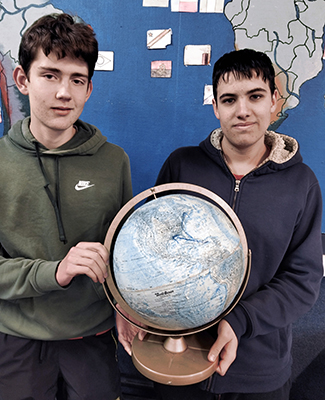
Geography Awareness Week has been a vibrant celebration of spatial thinking, environmental curiosity, and academic excellence across all year levels at Onslow College. From regional competitions to national selection pathways and unexpected outdoor classrooms, our geography students have demonstrated a remarkable passion for understanding the world around them.
Staff faced off against Ako classes to kick off the week with our Onslow Geography Quiz. Questions were challenging on Monday and grew easier each day, making quick submissions the key to earning ultimate bragging rights.
Maatangi Whenua Quiz Success
Off-site, Onslow had outstanding success at the annual Year 11 Maatangi Whenua Quiz, held at Victoria University of Wellington’s School of Geography and Earth Science. Year 11 students James Lloyd and Niko Fea-Hurst secured an impressive second-place finish in a field of 16 teams from across the Wellington region. Over eight rigorous rounds testing map reading, graph analysis, and core geographic concepts, the pair showcased exceptional technical skill. A bonus for the evening was hearing from Onslow graduate Luke Chowdhury (Class of 2021), currently undertaking postgraduate research on the seismic shaking of the Marlborough Fault system—providing an inspiring glimpse into possible tertiary pathways.
New Zealand Geography Olympiad Selection – final stages
Adding to the momentum, Year 12 students Matthew Power and Fletcher Steward achieved a major national milestone by reaching the final stage of selection for the New Zealand Geography Olympiad team, set to compete in Latvia in 2027. Having successfully navigated two demanding selection rounds—a resource interpretation module and a written examination covering climate change, resource management, natural hazards, and international trade—Matthew and Fletcher are now among the top 13 students nationwide from an initial pool of 400 applicants. They now head into an intensive fieldwork and team-bonding weekend where the final four-member squad will be chosen.
Experiential Weather and Climate Learning
Back on-site, nature provided the ultimate teaching aid when a snowfall coincided with a Year 11 weather unit. Rather than remaining indoors, students headed outside for an impromptu experiential learning session, connecting their classroom analysis of synoptic charts and low-pressure systems directly with the real-time atmospheric conditions unfolding around them.
Whether testing their knowledge against the region’s best, striving for international representation, or stepping out into the brief Wellington snowstorm to see theory come alive, our students have truly embodied the spirit of geographic exploration.